

Most businesses focus on getting more traffic. Smart businesses focus on maximising the value of the traffic they already have.
This is where Conversion Rate Optimization (CRO) becomes a growth multiplier.
CRO is not about tricks or dark patterns. It’s about understanding user behaviour, removing friction, and designing experiences that make it easier for customers to take action, whether that action is a purchase, lead submission, booking, or signup.
If acquisition brings people to your door, CRO decides how many walk in.
What Is Conversion Rate Optimization (CRO)?
Conversion Rate Optimization (CRO) is the systematic process of increasing the percentage of users who complete a desired action on your website, app, or landing page.
A conversion could be:
- Filling a lead form
- Making a purchase
- Booking a demo or site visit
- Signing up for a trial
- Clicking “Contact Us”
CRO Formula
Conversion Rate = (Conversions ÷ Total Visitors) × 100CRO improves results without increasing ad spend, which is why it delivers one of the highest ROIs in marketing.
Why CRO Matters More Than Ever
1️⃣ Rising Acquisition Costs
Paid media costs are increasing across Google, Meta, and marketplaces. CRO helps offset CAC by improving efficiency.
2️⃣ Better ROI from Existing Spend
Even a small uplift in conversion rate has a massive impact on revenue.
Example:
- 10,000 visitors × 2% conversion = 200 leads
- Improve to 3% = 300 leads
50% growth without more traffic
3️⃣ Improved Customer Experience
CRO is fundamentally about clarity, trust, and ease. Better UX = better conversions.
4️⃣ Data-Driven Decisions
CRO replaces assumptions with experimentation and evidence.
CRO Is Not Just About Landing Pages
A common misconception is that CRO = button color changes.
In reality, CRO spans the entire customer journey:
| Funnel Stage | CRO Focus |
|---|---|
| Awareness | Message clarity, relevance |
| Consideration | Trust, proof, content |
| Conversion | Friction removal |
| Post-conversion | Confirmation & next steps |
True CRO looks at behavior, intent, and context, not just UI.
Core Pillars of CRO
1. User Understanding
You can’t optimize what you don’t understand.
Key questions:
- Why do users drop off?
- What stops them from converting?
- What questions remain unanswered?
Tools:
- Session recordings
- Heatmaps
- Funnel analysis
- User surveys
2. Value Proposition Clarity
Users convert when they instantly understand:
- What you offer
- Why it matters
- Why you are different
Weak value propositions are the #1 CRO killer.
3. Experimentation & Testing
CRO is an ongoing process, not a one-time fix.
Types of tests:
- A/B testing
- Multivariate testing
- Copy tests
- Layout tests
Every test should answer a hypothesis, not random changes.
4. Friction Reduction
Friction is anything that makes users hesitate.
Common friction points:
- Long forms
- Confusing navigation
- Slow load times
- Unclear CTAs
- Too many choices
Removing friction often increases conversions more than adding features.
5. Trust & Credibility
Users convert when they trust you.
Trust signals include:
- Testimonials
- Reviews
- Case studies
- Security badges
- Clear pricing & policies
No trust = no conversion.
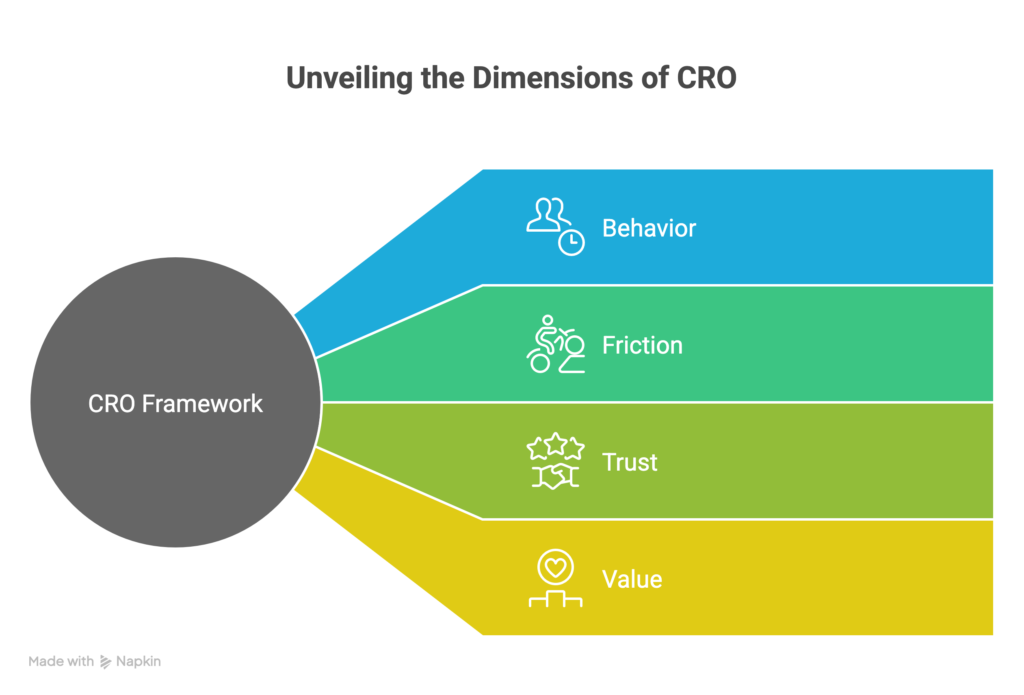
CRO Framework (Simple & Practical)
Step 1: Identify the Bottleneck
Use analytics to find where users drop off.
Step 2: Diagnose the Problem
Use qualitative data to understand why.
Step 3: Form a Hypothesis
Example:
“Reducing form fields from 7 to 4 will increase lead submissions.”
Step 4: Test the Change
Run A/B tests with statistically meaningful traffic.
Step 5: Learn & Iterate
Even failed tests produce insights.
CRO Examples Across Industries
D2C / Ecommerce
- Improve product page clarity
- Add “frequently bought together”
- Optimize checkout flow
BFSI
- Simplify application forms
- Add eligibility indicators
- Show security & compliance clearly
Real Estate
- Reduce lead form friction
- Add site-visit CTAs
- Improve project information clarity
EdTech
- Highlight outcomes & testimonials
- Simplify trial signup
- Add progress indicators
Case Study: CRO Impact Without More Traffic
Business: Lead-driven services company
Problem: High traffic, low lead conversion
Actions Taken:
- Reduced form fields from 9 → 5
- Improved headline clarity
- Added testimonials near CTA
Results:
- Conversion rate ↑ 67%
- Cost per lead ↓ 40%
- Lead quality ↑ significantly
No increase in traffic. Only better experience.
CRO Tools Stack
| Category | Tools |
|---|---|
| Analytics | GA4, Mixpanel |
| Heatmaps | Hotjar, Microsoft Clarity |
| A/B Testing | Google Optimize alternatives, VWO |
| Feedback | Surveys, on-site polls |
| Performance | Page speed & UX audits |
Tools don’t optimize conversions, decisions do.
Common CRO Mistakes
- ❌ Testing without enough traffic
- ❌ Changing multiple variables at once
- ❌ Ignoring mobile experience
- ❌ Optimizing for clicks, not outcomes
- ❌ Stopping after one successful test
CRO is a discipline, not a hack.
CRO Best Practices
- ✔ Optimize for clarity before creativity
- ✔ Test messaging before design
- ✔ Mobile-first optimization
- ✔ Focus on one primary CTA per page
- ✔ Use behavior data, not opinions
- ✔ Treat CRO as continuous improvement
FAQs
Some improvements are immediate; sustainable CRO is ongoing.
No, CRO applies to apps, emails, landing pages, and funnels.
No, it multiplies the effectiveness of paid marketing.
Final Thoughts
CRO is not about squeezing users into conversions. It’s about aligning your business goals with user intent.
Traffic is an opportunity. CRO is how you capitalize on it.
The brands that win don’t spend more, they convert better.


Leave a Reply