


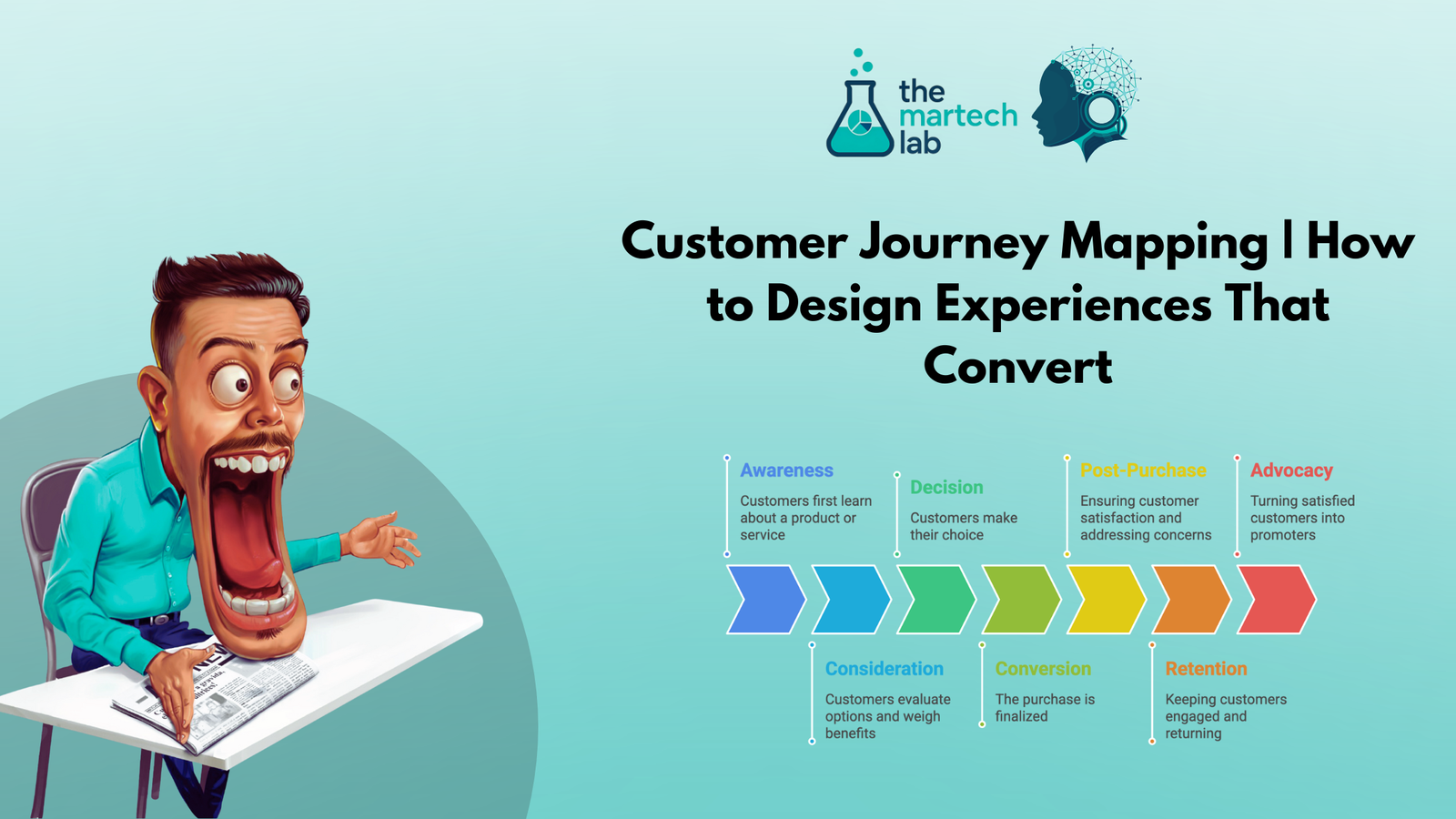
Learn how to create effective customer journey mapping to improve conversions, retention, and experience. Includes frameworks, examples, and common mistakes.
Customers don’t experience your brand in silos. They don’t think in terms of ads, emails, sales calls, or support tickets.
They experience a journey.
When brands fail to understand that journey, they create:
- Disconnected messages
- Frustrating handoffs
- Missed opportunities
- Poor conversions
Customer Journey Mapping solves this by helping teams visualize how customers move from awareness to conversion and beyond.
It’s not a UX exercise. It’s a revenue and experience strategy.
What Is Customer Journey Mapping?
Customer Journey Mapping is the process of visualizing every interaction a customer has with your brand across channels, touchpoints, and stages.
A journey map answers four critical questions:
- Where does the customer start?
- What actions do they take?
- What friction do they face?
- What should the brand do next?
Instead of guessing customer intent, you design for it.
Why Customer Journey Mapping Matters
1️⃣ Customers Are Non-Linear
A customer may:
- Discover you on Google
- Visit your website
- Leave
- See a WhatsApp message
- Read reviews
- Speak to sales
- Convert days later
Journey mapping embraces this reality.
2️⃣ Improves Conversion Rates
When you understand intent at each stage, you:
- Show the right message
- On the right channel
- At the right time
This directly improves conversions.
3️⃣ Reduces Drop-Offs & Leakage
Most drop-offs happen due to:
- Missing information
- Delayed follow-ups
- Channel mismatch
Journey maps expose these gaps clearly.
4️⃣ Aligns Teams
Marketing, sales, product, and support finally work from one shared view of the customer.
Customer Journey vs Funnel (Important Difference)
| Funnel | Journey |
|---|---|
| Linear | Non-linear |
| Brand-centric | Customer-centric |
| Assumes progression | Accepts looping & pauses |
| Focuses on conversion | Focuses on experience |
Funnels track outcomes. Journeys explain why those outcomes happen.
Core Stages of a Customer Journey
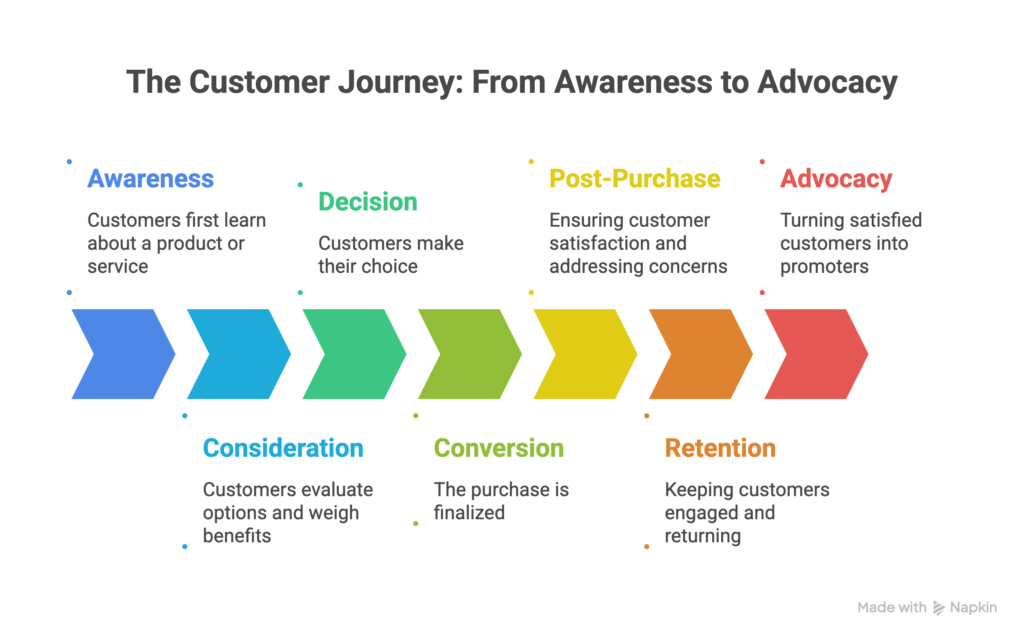
While journeys vary by industry, most follow these stages:
| Stage | Customer Mindset | Brand Objective |
|---|---|---|
| Awareness | “I have a problem” | Create relevance |
| Consideration | “Who can solve it?” | Build trust |
| Decision | “Should I act now?” | Reduce friction |
| Conversion | “I’ll go ahead” | Enable action |
| Post-Purchase | “Was this right?” | Reinforce confidence |
| Retention | “Should I return?” | Create habit |
| Advocacy | “I’ll recommend” | Amplify loyalty |
Key Elements of a Good Journey Map
A strong journey map includes:
1️⃣ Persona
Who is the customer? (New user, returning buyer, high-value customer, churn-risk)
2️⃣ Touchpoints
Every interaction:
- Ads
- Website pages
- Emails
- Calls
- App notifications
3️⃣ Customer Actions
What the customer does at each stage.
4️⃣ Emotions & Intent
Confusion, curiosity, urgency, hesitation these matter.
5️⃣ Pain Points
What blocks progress?
6️⃣ Brand Opportunities
Where can you:
- Clarify
- Nudge
- Assist
- Convert
How to Build a Customer Journey Map (Step-by-Step)
Step 1: Choose the Right Persona
Don’t map “all users”.
Start with:
- First-time buyer
- High-intent lead
- Repeat customer
Step 2: Define the Goal
Examples:
- Lead conversion
- Trial to paid
- Repeat purchase
- Renewal
Every journey must have a clear objective.
Step 3: List Touchpoints
Map every possible interaction online and offline.
Step 4: Identify Gaps & Friction
Ask:
- Where do users hesitate?
- Where do they drop off?
- Where do they need reassurance?
Step 5: Design Interventions
For each friction point, define:
- Message
- Channel
- Timing
This is where journeys become actionable.
Industry Examples
D2C / Ecommerce
Journey Goal: Increase first repeat purchase
- Awareness → Instagram ad
- Consideration → Product page
- Conversion → Checkout
- Post-purchase → WhatsApp usage tips
- Retention → Replenishment reminder
BFSI
Journey Goal: Loan application completion
- Awareness → Search ad
- Consideration → Eligibility calculator
- Decision → WhatsApp reminder
- Conversion → Assisted call
- Post-purchase → EMI reminders
Real Estate
Journey Goal: Site visit booking
- Awareness → Property listing
- Consideration → Project page
- Decision → WhatsApp brochure
- Conversion → Site visit scheduling
- Post-visit → Follow-up + offer
EdTech
Journey Goal: Trial to paid
- Awareness → Content marketing
- Consideration → Free trial
- Decision → Progress nudges
- Conversion → Pricing explanation
- Retention → Course completion reminders
Case Study: Journey Mapping Improves Conversion
Business: Service-based company
Problem: High lead volume, low conversions
What they discovered through journey mapping:
- Leads waited too long for follow-up
- No mid-funnel reassurance
- Sales contacted without context
Actions Taken:
- Added WhatsApp confirmation immediately after lead capture
- Sent trust-building content before sales calls
- Aligned CRM notes with marketing data
Results:
- Lead-to-sale conversion ↑ 41%
- Sales cycle time ↓ 28%
- Customer satisfaction ↑ significantly
Common Journey Mapping Mistakes
- Mapping only marketing touchpoints
- Ignoring post-purchase experience
- Creating journeys without data
- Treating journey mapping as a one-time exercise
- Designing journeys without automation capability
Journey maps must evolve with behavior.
Best Practices for High-Impact Journey Mapping
- Start simple – one persona, one goal
- Use real data, not assumptions
- Focus on friction before optimization
- Design journeys across channels, not within silos
- Connect journey maps to automation tools
- Review journeys every quarter
Journey Mapping vs Journey Orchestration
| Mapping | Orchestration |
|---|---|
| Strategy | Execution |
| Visual | Operational |
| Answers “what should happen?” | Ensures it actually happens |
| Planning | Automation |
Mapping comes first. Orchestration comes next.
FAQs
No. Even small teams benefit from clarity and alignment.
Detailed enough to reveal friction, simple enough to act on.
Whenever behavior, channels, or products change.
Final Thoughts
Customer Journey Mapping turns random touchpoints into intentional experiences.
Brands that win don’t just ask:
“How do we get more leads?”They ask:
“What does the customer need next?”When you design journeys with empathy, data, and purpose:
- Conversions improve
- Drop-offs reduce
- Loyalty increases
Journey mapping isn’t a diagram. It’s the blueprint for sustainable growth.


Leave a Reply