

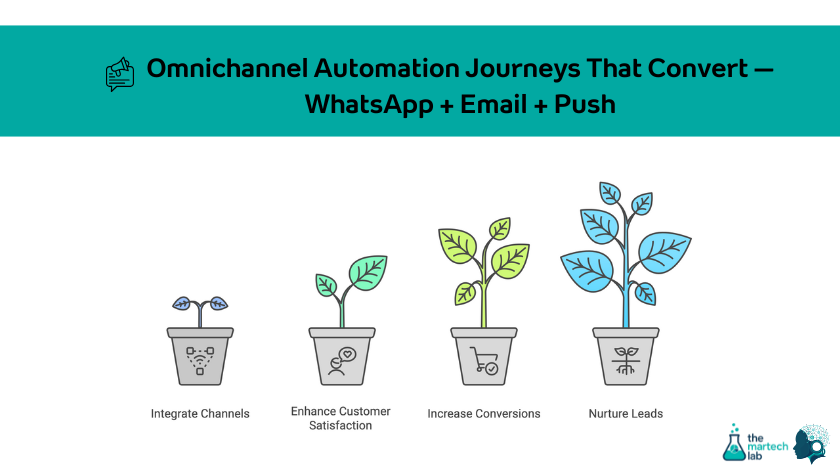
Learn how Indian brands use omnichannel automation across WhatsApp, Email, and Push to improve engagement and ROI. Includes journey templates and tools.
Introduction
In today’s day and age, marketing is no longer about sending more, it’s about sending right.
Your customer doesn’t live in one inbox anymore. They scroll Instagram, check WhatsApp, glance at email, and open your app, all in the same 10 minutes.
An omnichannel automation journey ensures your brand speaks consistently across every channel, without overwhelming your audience or burning your database.
Done right, it improves CTR, boosts retention, and makes your brand feel truly personal.
Done wrong, it leads to unsubscribes, spam flags, and wasted media budgets.
This guide breaks down exactly how Indian brands can design conversion-ready omnichannel workflows across WhatsApp, Email, and Push.
What Is an Omnichannel Automation Journey?
It’s a connected marketing workflow that uses multiple channels to nurture, engage, and convert users based on their real-time behavior.
Instead of sending the same blast everywhere, each user gets the next-best message on their preferred channel automatically.
Example:
- Lead fills out form → WhatsApp welcome message
- Doesn’t respond → Email follow-up after 2 hours
- Clicks link → Personalized push notification next day
- Converts → Exit from journey and start retention flow
Why It Matters in current situation
- Attention is fragmented: Indian users switch between 3–5 apps daily for information and shopping.
- Costs are rising: Ad CPCs on Meta/Google are up 25–40% YoY. Automation maximizes ROI from existing leads.
- Data is unified: With CDPs like Netcore, MoEngage, or Salesforce Data Cloud, you can now identify users across devices.
- WhatsApp dominates: With 500M+ active users, it’s India’s most reliable engagement channel.
Omnichannel automation = personalization × timing × consistency.
Channels in an Omnichannel Stack
| Channel | Role | Key Metrics |
| Fastest, most conversational | 90% open rate, 10–15% CTR | |
| Long-form storytelling | 25–40% open rate, 3–5% CTR | |
| Push Notifications | Instant engagement | 3–6% open rate |
| SMS (optional) | Fallback / compliance | 95% delivery |
Each channel plays a role. The magic lies in orchestrating them together.
BFSI Example – Auto Loan Journey
| Stage | Trigger | Channel | Message Example |
| Lead Captured | Form filled | “Thanks for showing interest in our Auto Loan, Rahul. Want to check your eligibility instantly?” | |
| No Response (2 hrs) | No click | “Complete your application to unlock a lower interest rate.” | |
| Partial Application | Uploaded documents | Push | “Almost done! Submit PAN to finish.” |
| Conversion | Loan approved | “Congrats! Loan approved. Tap to set EMI reminders.” | |
| Retention | Month 2 | “Refer a friend and earn cashback.” |
Results:
- 2.4x increase in lead-to-loan conversions
- 38% higher engagement on WhatsApp-first journeys
D2C Example – Cart Recovery Flow
| Stage | Trigger | Channel | Time Gap |
| Product Viewed | Browse event | Web Push | 15 mins |
| Added to Cart | Cart event | 30 mins | |
| Cart Abandoned | No purchase | 2 hours | |
| Discount Window | No response | 24 hours | |
| Purchase Done | Checkout success | Thank you + upsell |
Combining channels reduced abandonment from 72% → 48%.
Building Your Omnichannel Automation Framework
Step 1: Define Objectives
Is it for acquisition, onboarding, or retention?
E.g., Loan completion, product purchase, demo booking, subscription renewal.
Step 2: Identify Key Triggers
Events that should start a journey:
- Form submission
- App install
- Payment failure
- Webinar registration
- Abandoned cart
Step 3: Map Channels & Delays
Example flow:
Lead captured → WhatsApp (0 min)
↓
No click → Email (2 hr)
↓
No open → Push (1 day)
↓
Click → Retarget ad (3 days)
Step 4: Use Conditional Logic
Set “if/else” rules:
- If user clicked → move to next stage.
- If ignored → send fallback message via different channel.
Step 5: Measure, Optimize, Repeat Track conversion by journey, not just channel.
Use A/B tests for copy, timing, and offer type
Key Metrics to Track
| Metric | Ideal Range | Insight |
| Open Rate | WA > 85%, Email > 25% | Engagement health |
| CTR | WA > 10%, Email > 3%, Push > 2% | Message relevance |
| Response Rate | WA > 25% | Conversational quality |
| Conversion Rate | 4–8% overall | ROI effectiveness |
| Unsubscribe | < 0.3% | List hygiene |
Tech Stack for Indian Marketers
| Category | Recommended Tools | Use Case |
| Journey Builder / Automation | MoEngage Flows, WebEngage Journeys, Netcore Journey Designer, Salesforce Journey Builder | Cross-channel orchestration |
| WhatsApp API Partner | Gupshup, 360Dialog, AiSensy, Kaleyra | Verified messaging + template automation |
| Email Delivery | Netcore, Mailmodo, Sendgrid | Personalized campaigns + domain warm-up |
| Push / App SDK | Firebase, OneSignal, MoEngage | Real-time notifications |
| Analytics & CDP | GA4, Lemnisk, Segment | Event tracking + audience unification |
Integration across tools matters more than tool count.
Compliance & Consent
The DPDP Act (2025) demands explicit consent for all communication channels.
- Collect consent per channel (WhatsApp, Email, Push).
- Include “STOP” or unsubscribe links in every message.
- Store timestamp + purpose in your CRM/CDP.
- Register templates on DLT for WhatsApp/SMS.
Non-compliance = risk of TRAI suspension or ₹250 Cr fine.
Advanced Personalization Tactics
- Use AI-driven send-time optimization — messages delivered at the user’s active window.
- Personalize by intent, not name (e.g., “finish your application” vs “Hey Rahul”).
- Combine geo + behavior signals for hyperlocal relevance.
- Use dynamic coupons in WhatsApp / email templates.
- Sync journeys with CRM lead stages for sales alignment
Real Estate Example — Site Visit Automation
Trigger: Enquiry form filled
Flow:
- WhatsApp → “Thanks! Schedule your site visit for Dhananjay Heights.”
- No reply (2 hrs) → Email with brochure.
- Clicked but not booked → Push reminder next morning.
- Visit completed → WhatsApp feedback + referral offer.
Impact:
- Appointment booking rate ↑ 41%
- Post-visit follow-ups automated for 100% of leads
ROI Snapshot
| Channel Combo | Conversion Lift | CPA Reduction |
| WhatsApp + Email | +2.8x | −30% |
| Email + Push | +1.9x | −18% |
| WhatsApp + Email + Push | +3.4x | −37% |
The synergy effect of multi-channel automation far outperforms single-channel efforts.
“Omnichannel automation isn’t about more messages — it’s about fewer, smarter conversations.
The brand that orchestrates context, not chaos, wins 2025.”
— Nitin Vishwakarma, MarTech Strategist
FAQs
Yes. Tools like MoEngage Lite and WebEngage Starter offer plans from ₹10K/month
Usually yes, for speed, but use Email first for long-form storytelling.
2–3 integrated channels are enough — quality > quantity.
Weekdays 10 a.m.–12 p.m. and 7 p.m.–9 p.m. (based on Indian engagement data).
Final Thoughts
Omnichannel automation is the engine of modern MarTech, it blends data, timing, and storytelling into seamless experiences.
For Indian brands navigating high CAC, fragmented audiences, and consent laws, this approach delivers what ads alone can’t: Relevance, retention, and revenue.
Start small: automate one journey cart recovery, loan follow-up, or onboarding and watch how unified communication transforms your funnel.
Because in 2026, the brand that connects everywhere isn’t loudest it’s smartest.


Leave a Reply