

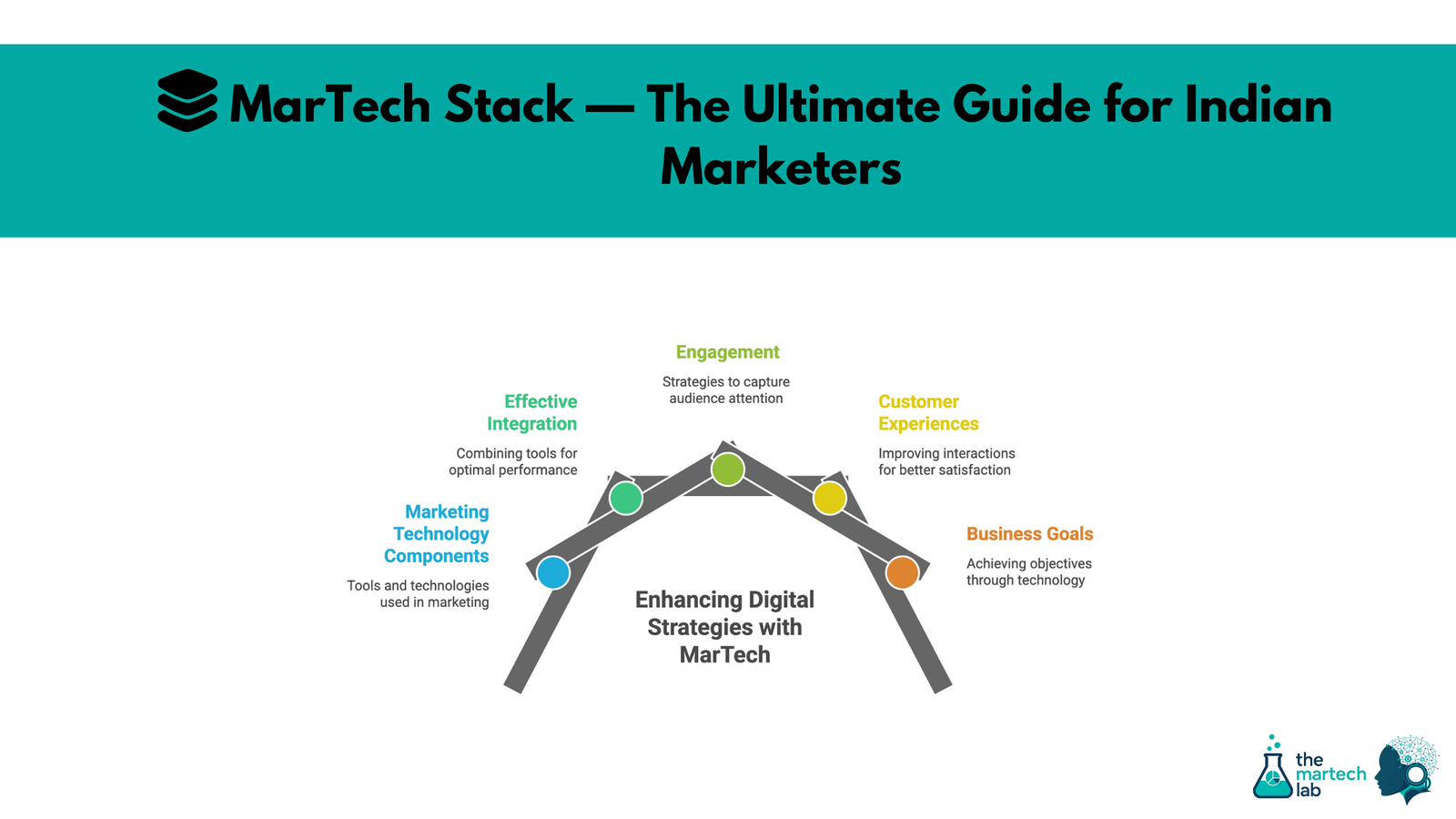
Discover the best MarTech tools and strategy to build your marketing stack in India. Includes CRM, automation, AI, data, and compliance recommendations.
Introduction
In current scenario, marketing success depends less on creativity alone and more on how your tools talk to each other.
From WhatsApp CRM to AI content engines, from CDPs to automation flows, Indian brands are now operating inside a technology ecosystem that’s evolving faster than ever.
But here’s the challenge: Most marketers don’t need more tools they need the right stack that actually drives revenue, compliance, and agility.
This blog is your complete playbook to building a future-ready MarTech stack designed specifically for the Indian market.
What Is a MarTech Stack?
A MarTech Stack is a combination of marketing technologies that help brands:
- Capture, store, and activate customer data
- Automate communication and personalization
- Measure ROI and optimize performance
It’s your marketing system’s nervous system connecting every touchpoint from first click to final sale.
Why You Need a Strong Stack now?
1. Marketing Complexity
Indian users now interact across WhatsApp, Meta, Google, OTT, email, and retail often within hours.
2. AI-Led Competition
AI-powered marketing automation is leveling the playing field smart systems now outperform large teams.
3. DPDP Act Compliance
The new Digital Personal Data Protection Act (India, 2025) enforces strict consent, retention, and transparency rules.
4. Cost Efficiency
An integrated stack eliminates silos, saving 25–40% in operational costs.
The best MarTech stacks don’t just collect data, they convert it into decisions.
The 6-Layer MarTech Framework
To design your perfect stack, think in layers rather than tools 👇
| Layer | Purpose | Example Tools (India 2026) |
|---|---|---|
| Data & Identity | Collect and unify customer data | Netcore, Lemnisk, Segment, Salesforce Data Cloud |
| CRM & Lead Management | Store and manage customer lifecycle | Zoho CRM, Leadsquared, Salesforce Sales Cloud |
| Automation & Journeys | Trigger communication and nurture flows | MoEngage, WebEngage, Netcore, HubSpot |
| Channels & Engagement | Deliver campaigns (Email, WhatsApp, SMS, Push) | Gupshup, AiSensy, Mailmodo, Twilio |
| Analytics & Attribution | Track performance, ROI, and cross-channel journeys | GA4, Mixpanel, Looker Studio, Power BI |
| AI & Optimization | Predict, personalize, and optimize marketing | ChatGPT, Writesonic, Jasper, Adobe Firefly |
Layer 1: Data & Identity
Data is the foundation of every modern marketing operation. By 2026, Indian marketers are shifting from cookies → consent-driven identifiers.
Must-Have Capabilities
- Unified customer profile (email + phone + device)
- Consent tracking & opt-in management
- Data enrichment from CRM, ads, and website
- Real-time event tracking
Tools:
- Netcore AI→ Indian-built, integrates deeply with WhatsApp and Email.
- Lemnisk → BFSI-focused CDP with predictive intelligence.
- Segment / mParticle → For global integrations.
Tip: Always map CDP consent rules to DPDP compliance logs.
Layer 2: CRM & Lead Management
Your CRM is your command center, it manages every inquiry, follow-up, and deal.
2025 Must-Have CRM Features
- Multi-source lead capture (Web, Ads, WhatsApp)
- Automated lead assignment
- Lead scoring
- Sales follow-up reminders
- Real-time dashboards
Tools (by industry):
- Real Estate → Leadsquared, Sell.Do
- BFSI → Zoho CRM, Salesforce Sales Cloud
- D2C → HubSpot, Freshsales
Integrate directly with your WhatsApp API provider for instant response automation.
Layer 3: Automation & Journeys
Automation is where marketing becomes scalable. It replaces manual follow-ups with smart, rule-based journeys that respond to behavior in real time.
Key Capabilities
- Multi-channel workflows (WA + Email + Push)
- Trigger-based nurturing (cart abandon, loan renewal)
- AI-based send-time optimization
- Journey analytics
Top Platforms in India (2025):
- MoEngage: Excellent for BFSI, Fintech, and Apps.
- WebEngage: Great for D2C & eCommerce.
- Netcore Cloud: Unified automation + AI recommendations.
- Salesforce Marketing Cloud: Enterprise-grade orchestration.
Pro Tip:
Connect your automation tool to CRM and CDP for closed-loop personalization.
Layer 4: Channels & Engagement
In 2025, Indian marketers must master conversational + contextual engagement.
| Channel | Best For | Leading Tools |
|---|---|---|
| Lead nurturing, reminders | Gupshup, AiSensy, 360Dialog | |
| Long-form storytelling | Mailmodo, Netcore, Sendgrid | |
| SMS / DLT | Compliance notifications | Textlocal, Kaleyra |
| Push Notifications | App & web retention | Firebase, MoEngage |
WhatsApp Is King
- 95% delivery rate
- 10–15% CTR
- DPDP-compliant with consent templates
Pro Tip: Use WhatsApp for first contact, email for depth, push for retention.
Layer 5: Analytics & Attribution
Without analytics, your stack is just noise. This layer connects ad spend → conversion → revenue.
Essential Features
- Channel-wise attribution
- Conversion tracking (GA4, Meta Pixel)
- Funnel drop-off insights
- Cross-channel dashboards
Tools:
- Google Analytics 4 (GA4): Must-have for web & app tracking.
- Mixpanel: Deep user journey analytics.
- Looker Studio / Power BI: Dashboard visualization.
Attribution Models to Use:
- Data-Driven (DDA): For large campaigns.
- Time Decay: For BFSI / long sales cycles.
- Linear: For real estate / multi-touch funnels.
Real value comes when analytics connects back into automation, not just reports.
Layer 6: AI & Optimization
By 2027, AI is no longer “coming soon” – it’s the engine of modern marketing.
Key Use Cases
- Predict next best offer / product
- Auto-generate copy or subject lines
- Sentiment-based lead scoring
- Smart budget allocation
Tools:
- ChatGPT / Writesonic: Copy & campaign ideation
- Adobe Firefly: Visual generation
- Jasper AI: Ad and blog automation
- Google AI Studio: Custom model training
AI doesn’t replace marketers, it amplifies them.
DPDP Compliance Across the Stack
India’s Digital Personal Data Protection Act (DPDP) applies across every layer.
- Obtain explicit opt-ins for all communications
- Store consent metadata (timestamp, channel, purpose)
- Offer one-click unsubscribe on email & WhatsApp
- Avoid sharing data across platforms without user disclosure
- Choose vendors with data localization (India servers preferred)
Compliant Platforms: Netcore, Lemnisk, Zoho, Gupshup, all India-hosted.
Example: BFSI Stack (2026)
| Layer | Tool | Use Case |
|---|---|---|
| CDP | Lemnisk | Customer unification + prediction |
| CRM | Zoho CRM | Lead management |
| Automation | MoEngage | Loan renewal journeys |
| Channel | Gupshup | WhatsApp engagement |
| Analytics | GA4 + Looker | Funnel performance |
| AI | ChatGPT + Google AI Studio | Offer personalization |
Outcome:
- 2.8x more renewals
- 35% lower CPA
- 4.6x campaign ROI
Example: Real Estate Stack
| Layer | Tool | Use Case |
|---|---|---|
| CDP | Netcore CDP | Lead unification |
| CRM | Leadsquared | Project-wise tracking |
| Automation | WebEngage | Site visit reminders |
| Channel | WhatsApp + Email (Gupshup + Mailmodo) | Brochures, follow-ups |
| Analytics | Power BI | Booking & ROI dashboards |
| AI | ChatGPT | Auto-generated follow-ups |
Impact:
- CPL ↓ 20%
- Lead-to-visit ↑ 42%
- ROI ↑ 3.8x
How to Build Your Own Stack
Step 1: Audit Your Current Tools
List what’s already working – remove duplicates.
Step 2: Identify Gaps
Do you lack automation? Attribution? Consent tracking?
Step 3: Prioritize Integration Over Expansion
Choose tools that connect easily via API, webhooks, or CDP syncs.
Step 4: Create a Single Data Source of Truth
Use a CDP or CRM as your central hub.
Step 5: Automate & Measure
Run quarterly audits to test data flow and ROI consistency.
Common Mistakes to Avoid
- Using too many disconnected tools
- Ignoring data privacy rules
- Focusing only on lead generation (not retention)
- Manual reporting
- No governance owner for MarTech stack
Each broken link costs both money and credibility.
Final Thoughts
The Indian MarTech revolution is entering its most exciting decade. Every brand from local D2C to national BFSI can now build enterprise-grade systems at SMB budgets.
Your goal isn’t to buy more tools, it’s to connect them better.
Because in 2025, success belongs to the marketer who knows what works, why it works, and how fast to act on it.
Build your stack like a strategy, not a spreadsheet. Automate intelligently. Integrate deeply. Measure relentlessly.
Your MarTech stack is no longer an investment, it’s your competitive advantage.
FAQs
Zoho CRM + WebEngage + Gupshup + GA4 = best value.
Yes, for dynamic copy, summaries, and FAQs via API.
Connect your ad pixels and CRM conversions into a unified analytics layer (GA4 or Looker Studio).
Typically 6–8 across CDP, CRM, automation, channel, analytics, and AI.


Leave a Reply