


Learn what data unification is, why a single customer view (SCV) is critical, and how Indian brands use it to improve personalization, retention, and ROI.
Introduction
Most marketing problems don’t start with poor campaigns. They start with fragmented data.
A customer clicks a Google Ads, chats on WhatsApp, opens emails, visits the website, and speaks to sales but each interaction lives in a different system. Marketing sees one version, sales sees another, and support sees none.
This disconnect leads to:
- Irrelevant messages
- Duplicate communication
- Poor personalization
- Lower conversions and retention
The solution is data unification creating a Single Customer View (SCV) that brings every interaction together into one reliable profile.
What Is Data Unification?
Data unification is the process of combining customer data from multiple sources into a single, consistent, and usable customer profile.
Instead of scattered records across tools, you get one source of truth.
Common data sources that need unification:
- CRM (sales and leads)
- Website and app analytics
- WhatsApp and email engagement
- Ad platforms (Meta, Google)
- Transaction and order data
- Customer support systems
When unified, this data forms a Single Customer View (SCV).
What Is a Single Customer View (SCV)?
A Single Customer View is a 360-degree profile that represents everything you know about a customer in one place.
A true SCV includes:
- Identity (email, phone, device)
- Demographics
- Behavior (visits, clicks, purchases)
- Engagement history (email, WhatsApp, push)
- Lifecycle stage
- Preferences and consent
Instead of asking “Who is this user?”, your systems already know.
Why a Single Customer View Matters
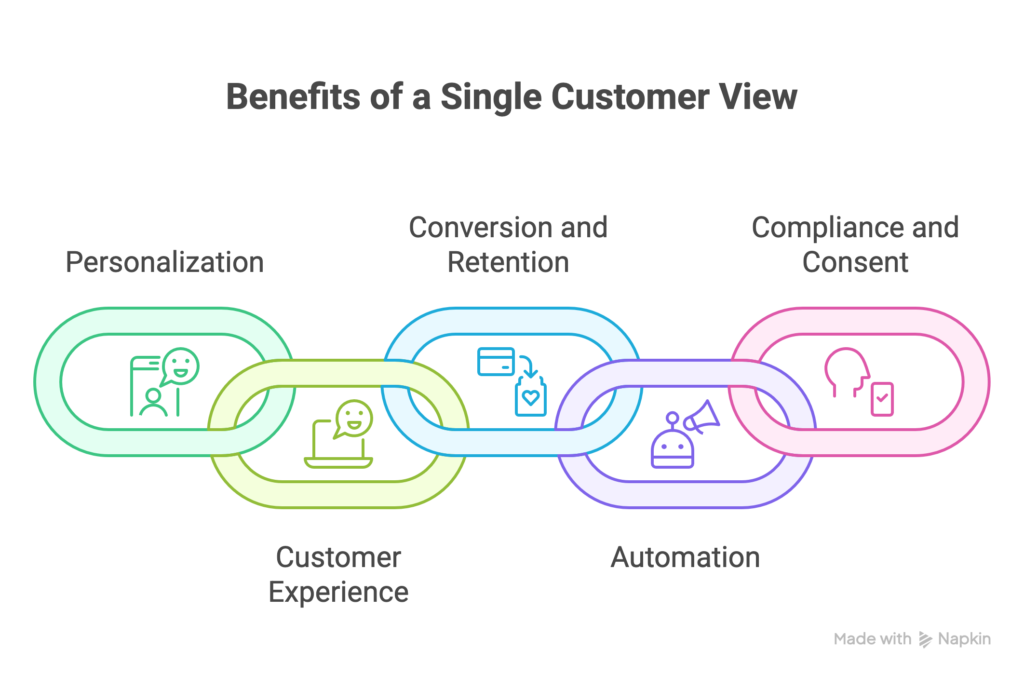
1️⃣ Personalization Actually Works
Without unified data, personalization is guesswork.
With SCV:
- Messages are relevant
- Offers match intent
- Timing improves dramatically
Personalization built on SCV consistently outperforms generic campaigns.
2️⃣ Better Customer Experience (CX)
Customers don’t want to repeat themselves.
When data is unified:
- Sales knows what marketing promised
- Support sees past interactions
- Customers feel understood, not treated like tickets
CX improves when systems talk to each other.
3️⃣ Higher Conversion and Retention
Unified data enables:
- Accurate segmentation
- Lifecycle-based journeys
- Timely nudges
Brands using SCV typically see:
- Higher conversion rates
- Lower churn
- Increased lifetime value (LTV)
4️⃣ Smarter Automation
Automation without unified data creates noise.
With SCV:
- Journeys trigger correctly
- Duplicates are avoided
- Customers don’t receive conflicting messages
Automation becomes intelligent, not repetitive.
5️⃣ Compliance and Consent Control
With evolving data privacy expectations, knowing what data you have and why is critical.
SCV helps:
- Track consent centrally
- Respect channel preferences
- Reduce compliance risk
The Problem with Fragmented Data
Most Indian businesses struggle with:
- Multiple CRMs
- Disconnected marketing tools
- Separate WhatsApp vendors
- Offline + online data silos
What this causes:
- Same customer treated as multiple users
- Repeated follow-ups
- Conflicting offers
- Poor attribution
- Wasted marketing spend
Fragmentation breaks trust internally and externally.
How Data Unification Works (Simplified)
1️⃣ Data Collection
Customer data is collected from all touchpoints.
2️⃣ Identity Resolution
Multiple identifiers (email, phone, device ID) are stitched together.
3️⃣ Profile Creation
A single customer profile is created and continuously updated.
4️⃣ Real-Time Sync
Changes in behavior update the profile instantly.
5️⃣ Activation
Unified data is used for segmentation, personalization, and automation.
Key Components of Data Unification
| Component | Role |
|---|---|
| Data Sources | CRM, analytics, ads, support |
| Identity Matching | Resolves duplicate users |
| Unified Profile Store | Central customer record |
| Real-Time Updates | Keeps data fresh |
| Activation Layer | Feeds CEP, CRM, campaigns |
| Consent Layer | Tracks permissions |
Tools That Enable Data Unification
Common categories:
- CDP (Customer Data Platform) – purpose-built for unification
- CRM with data sync – partial unification
- Data warehouses + connectors – technical approach
Popular tools used in India:
- Netcore CDP
- Lemnisk
- Segment
- Salesforce Data Cloud
- Zoho DataPrep (for SMBs)
A CEP uses unified data.
A CDP creates unified data.
Industry Examples
BFSI
Unified view connects:
- Loan applications
- KYC status
- WhatsApp reminders
- Payment behavior
Outcome: Faster approvals, better cross-sell, fewer drop-offs.
D2C / Ecommerce
Unified view connects:
- Browsing history
- Orders
- Returns
- Loyalty status
Outcome: Personalized recommendations and higher repeat purchases.
Real Estate
Unified view connects:
- Ad source
- Site visits
- Broker interactions
- CRM follow-ups
Outcome: Higher site-visit-to-booking conversion.
EdTech
Unified view connects:
- Course interest
- Trial usage
- Completion rates
- Support interactions
Outcome: Better trial-to-paid conversion.
Case Study: Data Unification Improves Retention
Business: Subscription-based D2C brand
Challenge: Low repeat purchases despite high traffic.
What they did:
- Unified website, order, WhatsApp, and email data
- Created one customer profile per user
- Built lifecycle-based journeys
Results:
- Repeat purchase rate ↑ 45%
- Message fatigue ↓ significantly
- Customer LTV ↑ 52%
Unification didn’t change products it changed outcomes.
Data Unification vs Data Collection
| Aspect | Data Collection | Data Unification |
|---|---|---|
| Focus | Gathering data | Connecting data |
| Outcome | Raw information | Actionable intelligence |
| Value | Low alone | High when activated |
| Usage | Reporting | Personalization & automation |
Collecting data is easy. Making it usable is the real challenge.
Common Mistakes to Avoid
- Treating CRM as a CDP
- Ignoring identity resolution
- Not syncing data in real time
- Building automation on partial data
- Over-collecting without purpose
More data ≠ better decisions.
Best Practices for Building a Single Customer View
- ✔ Start with key identifiers (phone, email)
- ✔ Unify high-impact data first (engagement + transactions)
- ✔ Keep profiles updated in real time
- ✔ Connect SCV to activation tools (CEP, CRM)
- ✔ Review data quality regularly
- ✔ Always respect consent and preferences
Final Thoughts
Data unification is not a technical upgrade it’s a marketing transformation.
When brands stop seeing customers as scattered events and start seeing them as complete journeys, everything improves:
- Messaging
- Timing
- Trust
- Revenue
A Single Customer View is the foundation of:
- Personalization
- Automation
- Retention
- Growth
In a world of fragmented attention, unified data is your biggest advantage.
FAQs
No. Even SMBs can build SCV using CRM + automation tools.
Not always, but CDPs make unification scalable and reliable.
Basic SCV can be built in weeks; mature systems evolve over time.
Yes, unified data directly improves conversion, retention, and efficiency.


Leave a Reply