


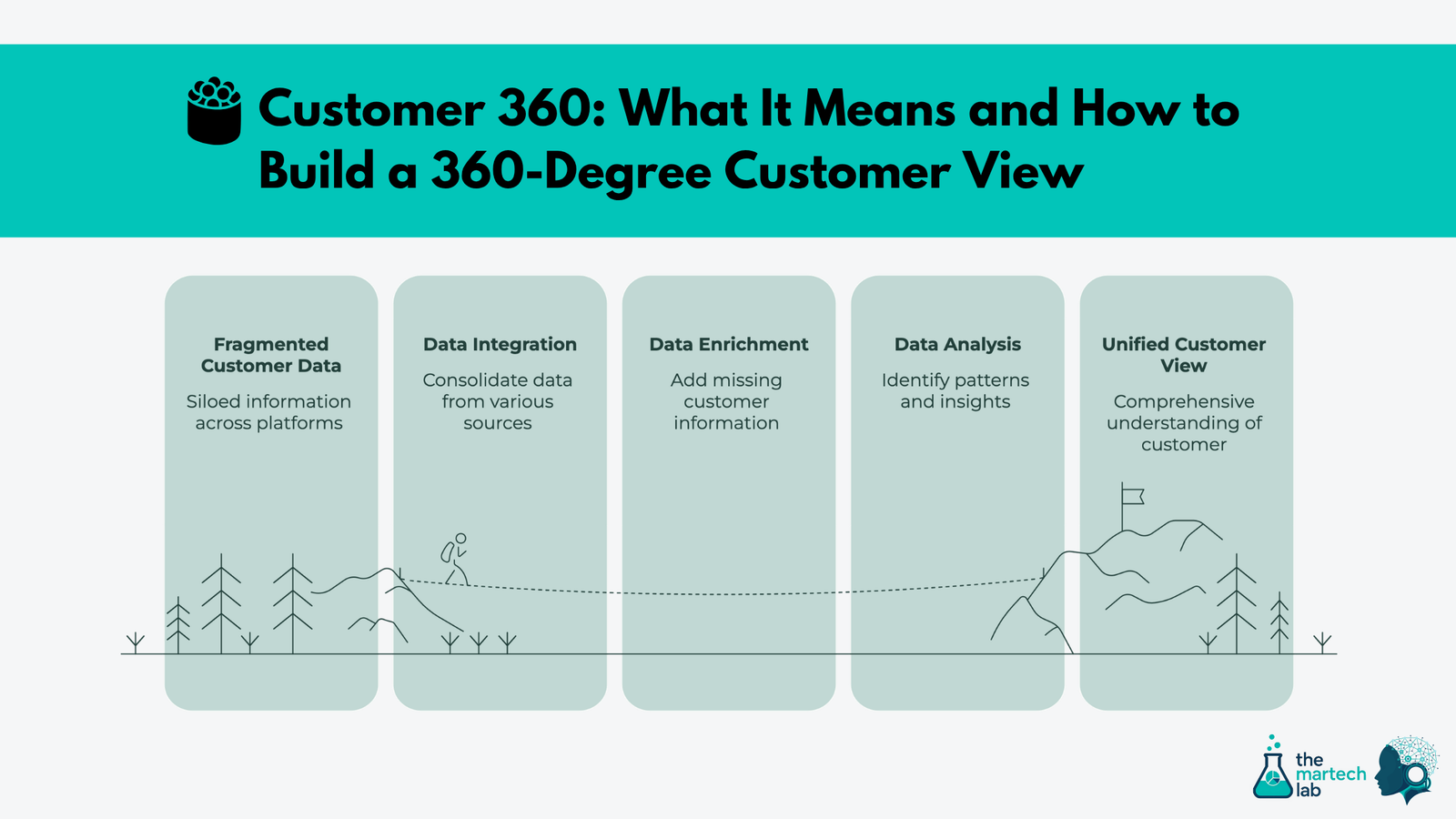
A customer rarely interacts with a business through just one channel.
They might discover a brand through Google, browse its website, download an app, receive an email, interact on WhatsApp, speak to sales, make a purchase and later contact customer support.
The challenge is that these interactions often live in different systems.
Marketing sees one part of the customer.
Sales sees another.
Customer support sees another.
Analytics may see something completely different.
This is where the concept of Customer 360 becomes important.
A Customer 360 view brings relevant customer information from different touchpoints together to create a more complete understanding of the individual customer.
But Customer 360 isn’t simply about putting more data on one screen.
The real objective is to create a trusted, connected and actionable customer profile that can help teams make better decisions and deliver more relevant experiences.
What Is Customer 360?
Customer 360 is a unified view of a customer’s interactions, behaviour, transactions, preferences and relationship with a business across relevant touchpoints.
Instead of treating every interaction as an isolated event, Customer 360 attempts to connect those interactions to the same customer.
For example, imagine a customer who:
- Visits your website
- Downloads a brochure
- Opens three emails
- Uses your mobile app
- Contacts customer support
- Purchases a product
- Responds to a WhatsApp campaign
A fragmented MarTech stack might store these activities across six different systems.
A Customer 360 approach aims to connect them into a coherent profile.
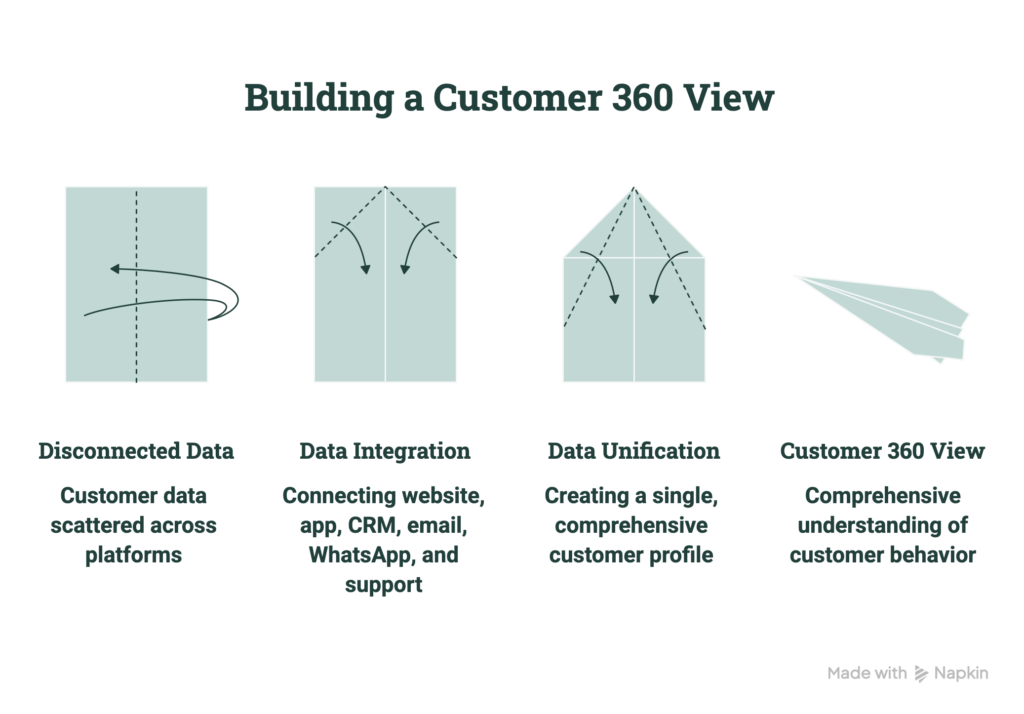
The result can look something like:
Customer
- → Identity
- → Demographics
- → Behaviour
- → Transactions
- → Engagement
- → Preferences
- → Service history
- → Consent
- → Lifecycle stage
- → Predicted intent
This gives businesses a much richer understanding of the customer.
Customer 360 vs Single Customer View
The terms Customer 360 and Single Customer View (SCV) are often used interchangeably, but there is a useful distinction.
A Single Customer View generally focuses on bringing fragmented customer information together.
Customer 360 goes a step further by emphasizing how that unified information can be used across the customer lifecycle.
In simple terms:
Single Customer View
"What information do we have about this customer?"Customer 360
"What do we know about this customer, what are they doing, what might they need next, and how should we respond?"Why Do Businesses Need Customer 360?
1. Customer Data Is Fragmented
Modern businesses typically use multiple systems:
- CRM
- Ecommerce
- Website analytics
- Mobile app
- Customer engagement platform
- Advertising platforms
- Customer support
- Loyalty systems
- Transaction systems
Each system may contain valuable information.
The problem is connecting it.
2. Customers Expect Context
Customers don’t think in terms of your internal systems.
They don’t think:
"This interaction belongs to the CRM team while my previous interaction belongs to marketing."They expect the brand to understand their context.
If a customer has already purchased a product, receiving an advertisement asking them to buy the same product again may create a poor experience.
A Customer 360 approach can help reduce these disconnects.
Without integration, teams can make decisions based on incomplete information.
What Data Goes Into a Customer 360 Profile?
A Customer 360 profile can contain many types of information.
Identity Data
- Customer ID
- Phone number
- Account information
- Device identifiers
Demographic Data
- Age group
- Location
- Customer type
- Relevant profile attributes
Behavioural Data
- Pages viewed
- Products searched
- App activity
- Content consumed
- Clicks
- Session behaviour
Transactional Data
- Purchases
- Orders
- Transaction value
- Product history
- Payment activity
Engagement Data
- Email opens
- Push interactions
- WhatsApp engagement
- SMS activity
- Campaign responses
Service Data
- Support tickets
- Complaints
- Calls
- Service interactions
- Resolution history
Preference and Consent Data
- Communication preferences
- Channel preferences
- Consent status
- Opt-outs
The exact information should depend on the organisation’s use cases, privacy requirements and governance framework.
How Does Customer 360 Work?
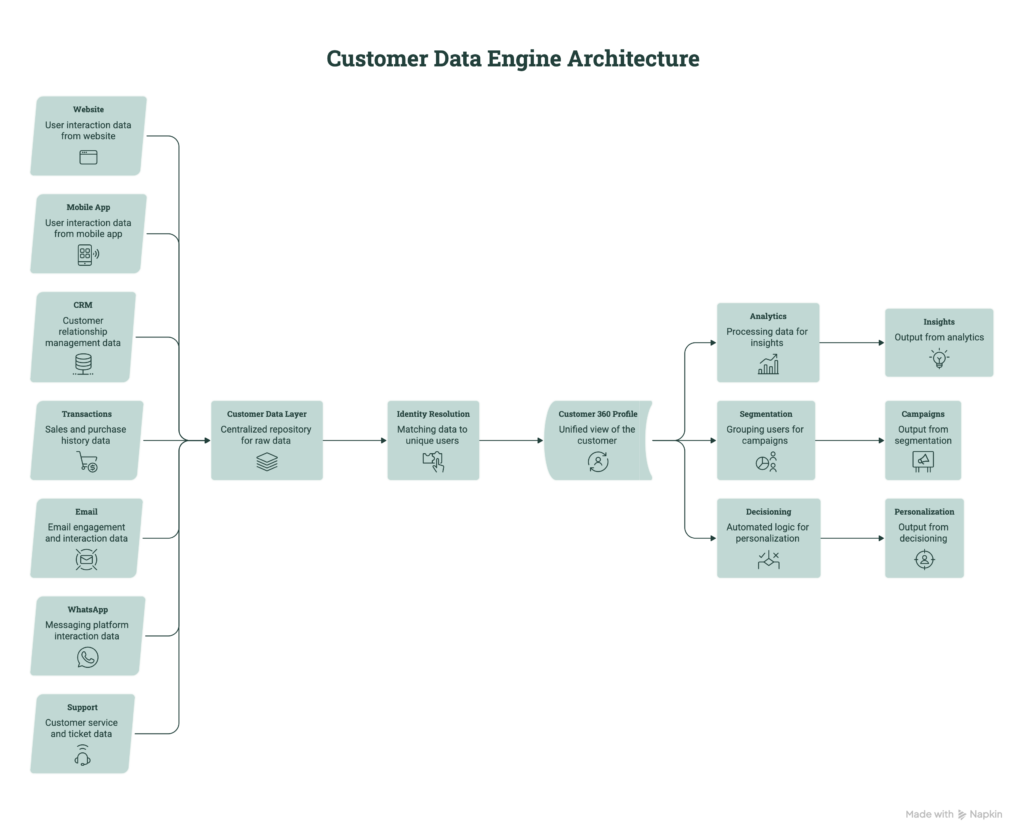
A typical Customer 360 architecture can be simplified into five stages.
1. Collect
Customer information is captured from different touchpoints.
2. Connect
Data from different systems is brought together.
3. Resolve
Different identifiers are matched to the correct customer.
4. Enrich
The customer profile is enhanced with behavioural, transactional and contextual information.
5. Activate
The profile is used for analytics, segmentation, personalization, engagement or decision-making.
The Role of Identity Resolution
You cannot create a reliable Customer 360 profile if you cannot determine that different interactions belong to the same person.
Consider this example:
Website: user_7821
CRM: CUST-4567
Mobile app: device_9832
WhatsApp: +91XXXXXXXXXX
These identifiers may represent the same customer.
Identity resolution attempts to connect these records using appropriate identifiers and matching logic.
This is why Customer 360 and Identity Resolution are closely connected.
Your existing Identity Resolution article can serve as the technical supporting piece here rather than repeating the complete concept in this article.
Customer 360 and the MarTech Stack
Customer 360 is not necessarily a standalone technology.
It is better understood as a capability created by multiple connected systems.
A modern architecture might include:
| MarTech Layer | Role |
|---|---|
| Data sources | Generate customer interactions |
| CRM | Manage relationships |
| CDP | Unify and activate customer data |
| Analytics | Understand behaviour |
| CEP | Engage customers |
| Journey orchestration | Coordinate experiences |
| AI/decisioning | Recommend next actions |
A CDP can play an important role in creating and activating unified customer profiles, but Customer 360 is ultimately a business outcome and operating model, not merely a product feature.
Customer 360 Use Cases
Personalized Marketing
A unified customer profile can help marketers understand:
- What the customer purchased
- What they viewed
- What they responded to
- Where they are in the lifecycle
This can support more relevant communication.
Cross-Sell and Upsell
Instead of promoting the same products to everyone, businesses can use customer history and behaviour to identify potentially relevant complementary products.
For example:
Product purchased
↓
Customer profile
↓
Relevant complementary category
↓
Personalized recommendation
This connects naturally with your existing Cross-Sell article.
Customer Retention
Customer 360 can also support retention.
Suppose a previously active customer suddenly:
- Stops opening communications
- Stops using the app
- Hasn’t purchased recently
- Shows declining engagement
Combining these signals can help identify customers who may require a retention or re-engagement strategy.
Customer Service
Customer service representatives can benefit from context.
Instead of asking the customer to repeatedly explain their history, the agent may be able to access relevant information such as:
- Previous interactions
- Purchases
- Support cases
- Communication history
- Account information
This can create a more connected experience.
Next Best Action
Customer 360 becomes even more powerful when combined with decisioning.
A business can move from:
"What do we know about the customer?"to:
"What should we do next?"For example:
Customer profile + recent behaviour + lifecycle stage
↓
Decision engine
↓
Next Best Action
↓
Relevant channel
This creates an important bridge between Customer 360 and AI-driven marketing.
Customer 360 for Indian Businesses
Customer 360 has particular relevance for Indian businesses because customer journeys increasingly span multiple digital and physical touchpoints.
Consider a financial services customer:
- Sees an advertisement
- Visits the website
- Calculates eligibility
- Starts an application
- Receives WhatsApp communication
- Speaks with a sales representative
- Completes documentation
- Becomes a customer
- Receives additional product offers
Each stage may generate data.
A Customer 360 approach can connect those signals so that future interactions reflect the customer’s actual relationship with the organization.
The same principle applies to:
- Banks
- Insurance companies
- NBFCs
- Ecommerce brands
- D2C businesses
- Real estate companies
- Telecom
- Travel
- Education
- Healthcare
Customer 360 and AI
Customer 360 becomes increasingly valuable as businesses adopt AI.
AI systems need relevant context to make useful decisions.
A fragmented profile might tell an AI system:
"Customer purchased Product A."A richer profile might provide:
Customer purchased Product A, browsed Product B twice, hasn't engaged for 30 days, prefers WhatsApp and belongs to a high-value customer segment.That additional context can support more sophisticated decisioning.
Potential AI use cases include:
- Churn prediction
- Next Best Action
- Product recommendations
- Offer optimization
- Customer intent detection
- Personalized content
- Channel selection
The principle is simple:
Better context → Better decisions → Better experiences
Common Customer 360 Challenges
Building a Customer 360 view isn’t simply an integration project.
Data silos
Customer information may be distributed across departments and platforms.
Duplicate profiles
The same customer may exist multiple times.
Poor data quality
Incorrect, outdated or incomplete information reduces profile reliability.
Identity complexity
Customers may use different identifiers across channels.
Privacy and consent
Organizations need appropriate controls around collection, processing and activation.
Organizational silos
Technology cannot solve every problem if marketing, sales, service and data teams operate independently.
Lack of use cases
Creating a unified profile without knowing how it will be used can produce an expensive data project with limited business value.
How to Build a Customer 360 Strategy
A practical approach is to start small.
Step 1: Define the business outcome
Start with a problem such as:
- Reduce churn
- Improve conversion
- Increase cross-sell
- Improve customer service
Step 2: Identify required data
Determine which information is actually needed.
Step 3: Map the customer journey
Identify where customer interactions occur.
Step 4: Connect identities
Determine how different identifiers can be matched.
Step 5: Unify the data
Create a reliable customer profile.
Step 6: Activate the profile
Use it for segmentation, analytics, personalization or engagement.
Step 7: Measure outcomes
Track business impact rather than simply the number of profiles created.
How to Measure Customer 360 Success
Useful metrics can include:
- Percentage of customers with unified profiles
- Identity match rate
- Duplicate profile reduction
- Data completeness
- Customer identification rate
- Personalization uplift
- Conversion rate
- Cross-sell rate
- Retention rate
- Customer lifetime value
- Customer service resolution time
The most important measurement is ultimately:
Does having a better customer view lead to better business and customer outcomes?Customer 360 vs CDP
These concepts are related but shouldn’t be treated as identical.
| Customer 360 | CDP |
|---|---|
| Business capability | Technology platform |
| Unified understanding of customer | Helps collect and unify customer data |
| Can involve multiple systems | One component of the MarTech architecture |
| Focuses on customer context | Focuses on data management and activation |
| Supports business decisions | Supports segmentation, activation and personalization |
A CDP may be a key part of your Customer 360 architecture, but Customer 360 is bigger than the CDP itself.
Frequently Asked Questions
Customer 360 is a unified view of a customer’s interactions, behaviour, transactions, preferences and relationship with a business across relevant touchpoints.
A 360-degree customer view brings relevant information from multiple customer touchpoints together to create a more complete customer profile.
No. A CDP is a technology platform that can help unify and activate customer data. Customer 360 is the broader capability of creating and using a connected view of the customer.
Depending on the organization, it can include identity, demographic, behavioural, transactional, engagement, service, preference and consent information.
It can help organizations understand customers more completely, reduce disconnected experiences and support better personalization, analytics, service and decision-making.
Final Thoughts
Customer 360 isn’t about collecting every possible piece of information about a customer. It’s about creating useful customer context. The strongest Customer 360 strategies connect four things:
Identity
Who is this customer?
Behaviour
What are they doing?
Context
What is happening in their relationship with the business?
Action
What should the business do next?
That final step is what separates a customer database from a genuinely useful Customer 360 capability.
When customer data is unified, identities are resolved, privacy is respected and the resulting profile is connected to engagement and decisioning systems, businesses can move from fragmented interactions to connected customer experiences.
And that is ultimately what Customer 360 is designed to achieve.


Leave a Reply