


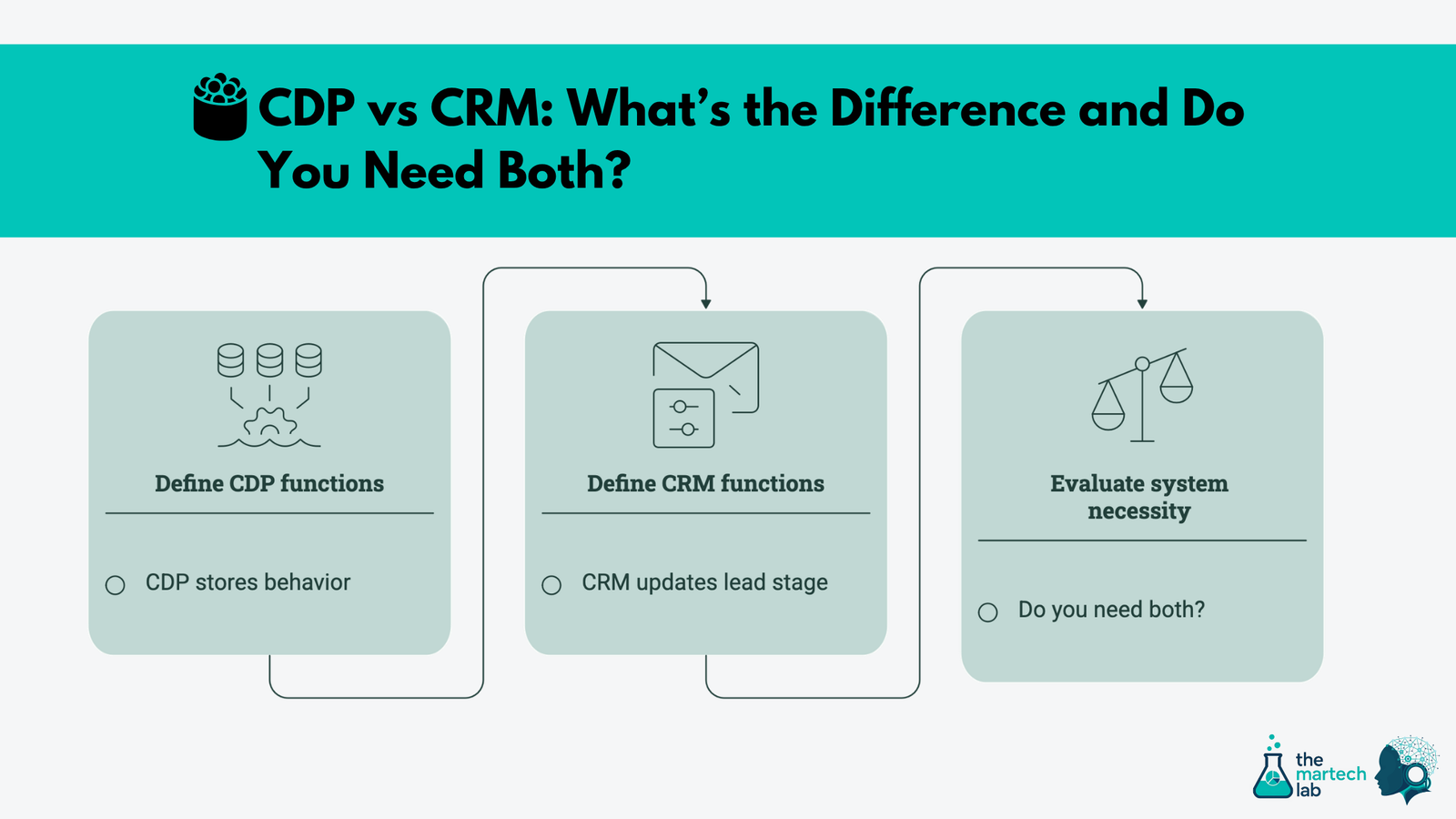
CDP vs CRM is one of the most common questions businesses face when building or upgrading their MarTech stack.
At first glance, the two platforms can appear similar. Both store customer information. Both help businesses understand customers. Both can support personalisation, sales and customer engagement.
But they are built for different purposes.
A CRM (Customer Relationship Management) system primarily helps businesses manage relationships and interactions with known prospects and customers.
A CDP (Customer Data Platform) brings customer data together from multiple sources, resolves identities and creates unified customer profiles that can be used for analytics, segmentation, personalisation, and activation.
The important question, therefore, isn’t simply:
"CDP or CRM?"For many organizations, the better question is:
"How should my CDP and CRM work together?"This distinction becomes particularly important for Indian businesses operating across websites, mobile apps, WhatsApp, email, paid advertising, sales teams, call centres and offline channels.
What Is a CRM?
A Customer Relationship Management (CRM) platform is designed to help businesses manage their interactions and relationships with prospects and customers.
A CRM typically stores information such as:
- Name and contact details
- Leads and opportunities
- Sales pipeline
- Sales activity
- Call notes
- Emails
- Customer service interactions
- Account information
- Follow-up tasks
- Purchase or deal history
The CRM is usually the operational system used by sales, service and customer-facing teams.
For example, a salesperson might open a customer’s CRM record before making a call and see:
Lead generated → Demo completed → Proposal sent → Follow-up pendingThe CRM tells the salesperson what has happened in the relationship and what needs to happen next.
What Is a CDP?
A Customer Data Platform (CDP) is designed to collect and unify customer data from multiple systems and touchpoints into persistent customer profiles.
A CDP can bring together information from:
- Website
- Mobile application
- CRM
- SMS
- Advertising platforms
- Ecommerce systems
- Transactions
- Customer support
- Loyalty programs
- Offline interactions
The result is a more comprehensive view of the customer.
For example, a customer profile could combine:
CRM data
→ Existing customer
Website behaviour
→ Viewed three products
Email behaviour
→ Opened two promotional emails
Transaction data
→ Purchased once
WhatsApp behaviour
→ Clicked an offer
App behaviour
→ Logged in twice this week
The CDP can bring these signals together to help marketing teams understand what the customer is doing, not just who the customer is.
CDP vs CRM: The Core Difference
The simplest way to understand the difference is:
CRM manages customer relationships. CDP unifies customer data.A CRM is primarily relationship and workflow oriented.
A CDP is primarily data, identity and activation oriented.
| Capability | CRM | CDP |
|---|---|---|
| Primary purpose | Relationship management | Customer data unification |
| Main users | Sales, service, account teams | Marketing, analytics, CX, data teams |
| Known customers | ✅ | ✅ |
| Anonymous behaviour | Limited | ✅ |
| Behavioural data | Limited/varies | ✅ |
| Identity resolution | Limited/varies | Core capability |
| Sales pipeline | ✅ | Usually not primary |
| Customer profile | Contact/account focused | Unified behavioural + transactional profile |
| Segmentation | Basic to advanced | Advanced behavioural segmentation |
| Personalization | Supported | Major use case |
| Real-time event data | Limited/varies | Common capability |
| Marketing activation | Via integrations | Core capability |
| Sales workflow | Core capability | Usually secondary |
The exact capabilities vary between vendors, so this table should be viewed as a conceptual distinction rather than a rule that applies identically to every platform. Major CDP and CRM vendors also increasingly overlap in functionality.
CRM vs CDP: How They Handle Customer Data
One of the biggest differences is where the data comes from.
A CRM generally focuses on information associated with known contacts, accounts, leads and interactions managed by customer-facing teams.
A CDP can ingest much broader behavioural and transactional signals.
Consider a visitor to an ecommerce website.
Before the person logs in, the website may know:
- Pages visited
- Products viewed
- Search queries
- Time spent
- Campaign source
After login, those behaviours can potentially be associated with an identified customer profile.
That creates an important distinction:
CRM:
“Here is the customer record.”
CDP:
“Here is the customer record plus the customer’s behaviour across connected touchpoints.”
This is why CDPs are particularly useful for modern personalization and customer engagement programs.
Do You Need a CDP If You Already Have a CRM?
Not necessarily.
A CRM may be sufficient if your business:
- Has relatively simple customer journeys
- Has limited digital behavioural data
- Primarily needs sales pipeline management
- Has fewer customer touchpoints
- Doesn’t require complex real-time personalization
But a CDP becomes increasingly useful when your business has:
- Multiple customer data sources
- Large digital audiences
- Website and app behavioural data
- Multiple engagement channels
- Complex customer journeys
- Large-scale personalization requirements
- Multiple customer identifiers
- Data silos between marketing and sales
The question shouldn’t be whether a CDP is technologically impressive.
It should be whether your customer data problem justifies one.
When Should a Business Invest in a CDP?
Here are some practical signals.
1. Your customer data exists in too many systems
If marketing has one dataset, sales has another and customer engagement platforms have another, a CDP may help create a more unified data layer.
2. You cannot identify the same customer across channels
If a customer browses on your website, uses your app and later interacts with WhatsApp but each interaction appears as a separate profile, identity resolution becomes important.
3. Personalization is mostly rule-based
If your personalization depends only on basic attributes such as location or age, you may not need a sophisticated CDP yet.
But if you want personalization based on real-time behaviour, purchase history, engagement and intent, a CDP can become valuable.
4. Marketing teams depend heavily on IT for audience creation
A CDP can allow marketing teams to create and activate audiences using unified customer data, depending on the platform architecture and governance model.
5. You want real-time customer journeys
Real-time event data can help trigger actions based on what customers are doing now rather than relying entirely on historical CRM records.
CDP and CRM: Why Businesses Often Need Both
A common misconception is that adopting a CDP means replacing the CRM.
In many MarTech stacks, that isn’t the goal.
Instead, the two platforms can work together.
Consider this flow:
Website + App + Transactions + Email + WhatsApp
↓
CDP
↓
Unified Customer Profile
↓
Segmentation / Analytics / Decisioning
↓
CRM + CEP + Advertising + Personalization
The CDP becomes the customer data and intelligence layer, while the CRM continues to manage customer-facing relationships and workflows.
For example, the CDP might identify that a customer:
Viewed a product three times + opened an offer + abandoned checkout.That insight can then be passed into connected systems.
The CRM could create a sales task.
A customer engagement platform could trigger a personalized message.
An advertising platform could suppress an irrelevant campaign.
This is where the combination becomes powerful.
CDP vs CRM for Indian Businesses
The distinction becomes particularly relevant in India’s increasingly omnichannel customer environment.
Consider a financial services customer.
They may:
- Click a Google advertisement
- Visit a website
- Submit a lead form
- Receive a WhatsApp message
- Speak to a call-centre agent
- Complete KYC
- Use a mobile application
- Receive an offer later
A CRM may effectively manage the lead, sales process and customer relationship.
But a CDP can help connect the behavioural and transactional signals surrounding that customer journey.
The same concept applies to:
- BFSI
- Ecommerce
- D2C
- Real estate
- Travel
- Healthcare
- Education
- Telecom
The more fragmented the customer journey becomes, the more valuable unified customer data becomes.
CDP vs CRM vs Data Warehouse
Another common source of confusion is the difference between a CDP, CRM and data warehouse.
They are not interchangeable.
| Platform | Primary role |
|---|---|
| CRM | Manage customer relationships |
| CDP | Unify and activate customer data |
| Data Warehouse | Store and analyze enterprise data |
A data warehouse may contain enormous amounts of business information.
A CDP is typically designed around customer identity, profiles, segmentation and activation.
A CRM focuses on relationships and operational workflows.
Modern architectures can connect all three.
Where Does a CEP Fit?
A Customer Engagement Platform (CEP) sits closer to the activation layer.
A simplified MarTech architecture might look like:
Data Sources
→ Website
→ App
→ CRM
→ Transactions
→ Ads
→ Support
CDP / Customer Data Layer
↓
Customer Profile + Identity + Segmentation
↓
CEP / Engagement Layer
↓
Email + WhatsApp + SMS + Push + In-App
↓
Customer
Common Mistakes When Comparing CDP and CRM
Treating the CDP as a replacement for CRM
They generally solve different problems.
Buying a CDP before fixing data quality
A CDP cannot magically fix every underlying data problem.
Assuming every CRM is the same
CRM capabilities vary considerably between platforms.
Focusing only on technology
The business use case should come first.
Ignoring identity resolution
A unified profile is only useful if the underlying identity logic is reliable.
Forgetting governance and consent
Customer data activation must operate within the organization’s privacy, security and governance requirements.
How to Decide: CDP or CRM?
Use this simple framework.
Choose CRM first if:
- Your primary problem is sales management
- Your sales pipeline needs structure
- Teams need better follow-up management
- Customer service workflows are fragmented
- You have limited behavioural data requirements
Consider a CDP if:
- Customer data exists across many systems
- You need unified customer profiles
- Behavioural data is important
- You want advanced segmentation
- You need real-time personalization
- Your customer journeys span many channels
Consider both if:
Your organization has a mature sales operation and a complex digital customer journey.
For many larger organizations, the strongest architecture isn’t CDP vs CRM.
It is:
CDP + CRM + Engagement Platform + AnalyticsFrequently Asked Questions
Not necessarily. They solve different problems. A CRM focuses primarily on customer relationship and operational workflows, while a CDP focuses on unifying customer data and making it available for analytics, segmentation and activation.
For some businesses, yes. If customer data requirements are relatively simple, a CRM may be enough. However, complex behavioural, cross-channel and real-time personalization requirements may require CDP capabilities.
Yes. A CDP can enrich CRM records with broader customer behaviour and unified data, while CRM activity can contribute information back to the customer profile.
No. Depending on the implementation, unified customer data can support marketing, sales, customer experience, analytics and service teams.
The simplest distinction is: CRM manages customer relationships; CDP unifies customer data across touchpoints.
Final Thoughts
The CDP vs CRM debate shouldn’t be treated as a competition between two technologies.
They address different layers of the customer ecosystem.
A CRM helps your teams answer:
Who is the customer, what relationship do we have with them, and what should our team do next?A CDP helps answer:
What do we know about this customer across all their interactions, and how can that information be used to create a better experience?When connected properly, the two can become significantly more powerful together.
For organizations moving toward personalization, omnichannel engagement, real-time decisioning and AI-driven marketing, understanding the difference between CRM and CDP is therefore an important part of building the right MarTech architecture.
The goal isn’t to collect more customer data.
The goal is to make customer data connected, understandable and actionable.


Leave a Reply