


For years, digital marketing relied heavily on third-party audiences, cookies and data available through advertising platforms.
That model is changing.
Privacy regulations, browser changes, platform restrictions and growing consumer awareness have made first-party data increasingly important for marketers.
But collecting customer data is not the same as having a first-party data strategy.
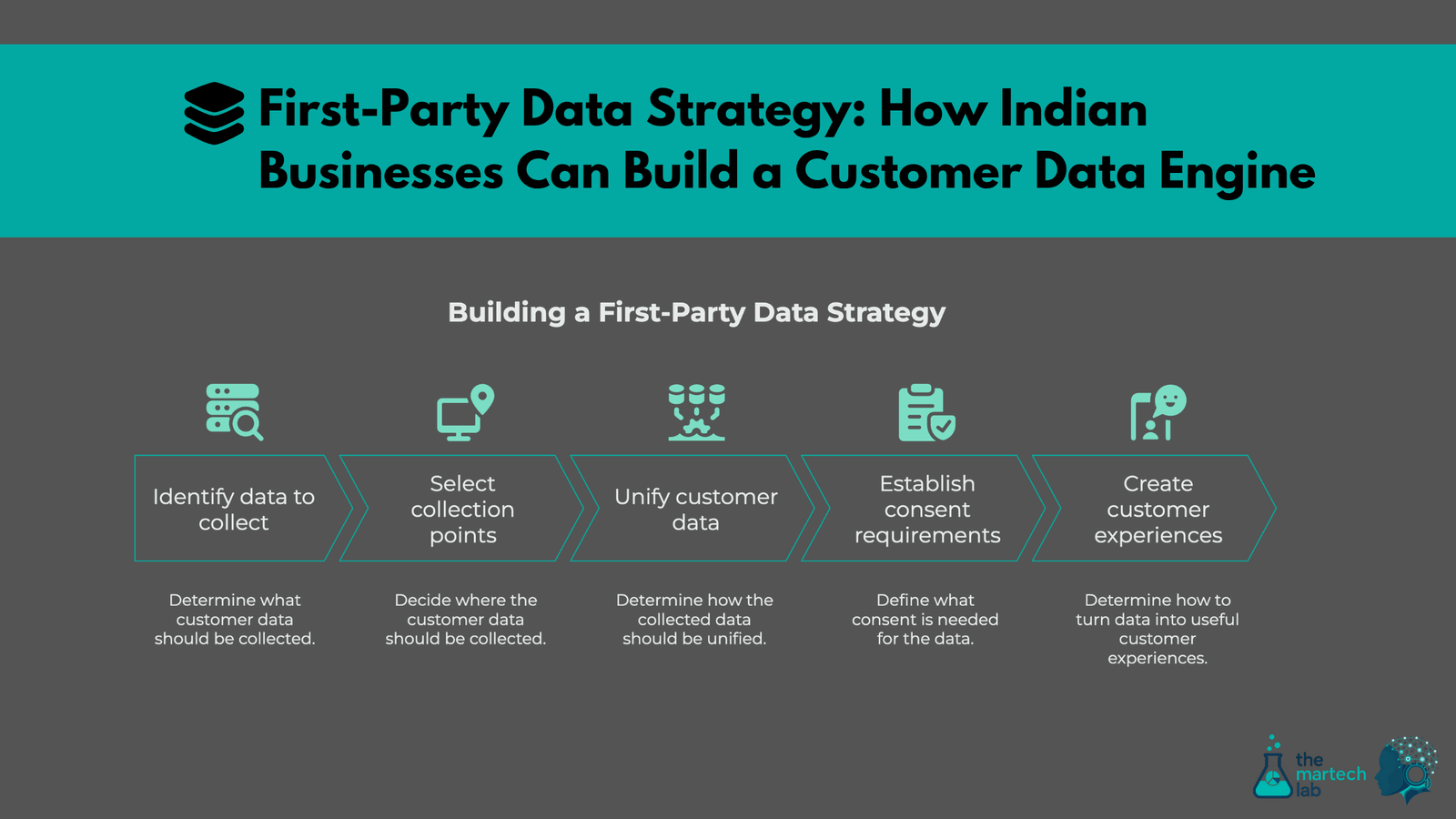
A strong strategy answers five fundamental questions:
- What customer data should we collect?
- Where should we collect it?
- How should we unify it?
- What consent do we need?
- How can we turn that data into useful customer experiences?
For Indian businesses operating across websites, mobile apps, WhatsApp, physical stores, call centres, CRM systems and digital advertising, first-party data can become one of the most valuable assets in the MarTech stack.
The next step is understanding how to build the strategy itself.
What Is First-Party Data?
First-party data is information that a business collects directly from its customers or users through its own channels and interactions.
Examples include:
- Name and contact information
- Website interactions
- Mobile app activity
- Purchase history
- Product preferences
- Email engagement
- Customer service interactions
- Loyalty activity
- Form submissions
- Survey responses
- Account information
- Communication preferences
For example, if a customer purchases a product from your website, the purchase information is first-party data.
If that customer subsequently:
Opens an email → visits the website → uses your app → contacts support → makes another purchasethose interactions can also contribute to your first-party customer data, subject to applicable permissions and your data practices.
The important distinction is direct relationship.
The business collects the data through its own customer interactions rather than buying an audience from an external data provider.
Why Is First-Party Data Important?
1. Greater Control Over Customer Data
When businesses depend heavily on external audience platforms, they have limited control over how audiences are defined and activated.
First-party data gives organizations greater control over the information they collect directly and how it is organized and used, subject to consent, privacy and governance requirements.
2. Better Customer Understanding
A customer may interact with a brand dozens of times before purchasing.
First-party data can connect these interactions to create a richer understanding of customer behaviour.
Instead of simply knowing:
"This person purchased Product A."a business may understand:
"This customer discovered us through search, viewed Product A several times, compared two products, interacted with an email and eventually purchased."That context can improve future customer experiences.
3. More Relevant Personalization
Personalization works best when it is based on meaningful customer signals.
First-party data can support use cases such as:
- Product recommendations
- Personalized offers
- Lifecycle communication
- Re-engagement
- Cross-sell
- Loyalty programs
- Content recommendations
The objective isn’t simply to personalize everything.
It is to use relevant customer information to make interactions more useful and contextual.
First-Party vs Second-Party vs Third-Party Data
Understanding the terminology is important.
| Data Type | What It Means |
|---|---|
| First-party data | Data collected directly by your organization |
| Second-party data | Another organization’s first-party data shared through an agreed relationship |
| Third-party data | Data collected or aggregated by an external organization from multiple sources |
For modern customer engagement, first-party data is particularly valuable because it is directly connected to the organization’s own customer relationships and experiences.
What Is a First-Party Data Strategy?
A first-party data strategy is a structured approach to collecting, managing, governing and activating customer data that a business obtains directly through its own interactions and channels.
It typically covers:
- Data collection
- Consent
- Identity
- Data unification
- Segmentation
- Activation
- Measurement
- Governance
A useful way to think about it is:
Collect → Connect → Understand → Activate → Learn
The cycle then repeats as new customer interactions generate additional data.
How to Build a First-Party Data Strategy
Step 1: Identify Your Data Sources
Start by mapping where customer data currently exists.
For an Indian organization, this could include:
- Website
- Mobile application
- CRM
- Ecommerce platform
- POS systems
- Call centre
- Email platform
- Loyalty program
- Customer support
- Surveys
- Offline stores
Create a simple inventory before buying another technology platform.
Step 2: Define What Data You Actually Need
More data does not automatically mean better marketing.
Define the information required for specific business use cases.
For example:
Use case: Cart abandonment
You may need:
- Customer identifier
- Product viewed
- Cart value
- Time of abandonment
- Communication preference
Use case: Customer retention
You may need:
- Purchase frequency
- Product usage
- Engagement history
- Customer lifecycle stage
Start with business problems, then determine the data required to solve them.
Step 3: Build a Consent Framework
First-party data strategy cannot be separated from privacy.
Customers should understand:
- What data is being collected
- Why it is being collected
- How it will be used
- Which communications they are agreeing to
- How they can withdraw or modify permissions
Consent should also flow into downstream marketing and engagement systems so that customer preferences are respected.
This becomes especially important as Indian businesses operationalize requirements under India’s Digital Personal Data Protection framework.
Your existing Consent Management article can become the supporting internal link for this section.
Step 4: Create a Consistent Customer Identity
A customer can appear differently across systems.
For example:
Website
user123
CRM
Customer ID 4567
Mobile App
Device ID XYZ
Phone number
Without identity resolution, these may appear to be different users.
A first-party data strategy therefore needs a consistent approach to customer identity and profile stitching.
This is where your existing Identity Resolution and Data Unification articles fit naturally into the cluster.
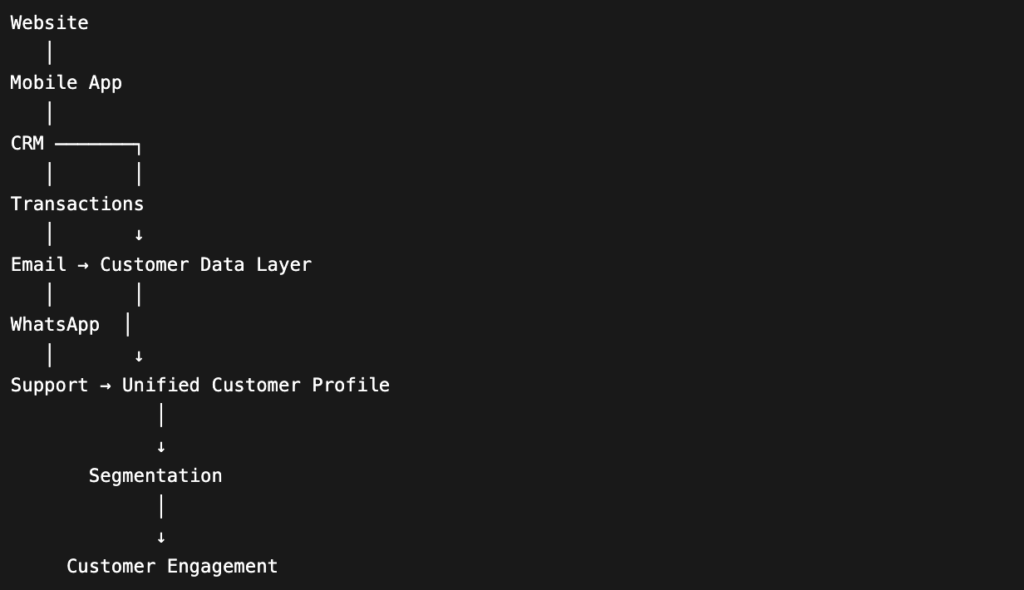
Step 5: Unify the Data
Once identities are connected, customer information can be brought together.
A simplified architecture could look like:
Step 6: Turn Data Into Segments
Unified data becomes useful when marketers can act on it.
Instead of sending one campaign to every customer, create meaningful segments.
For example:
High-value customers
Customers with high lifetime value.
At-risk customers
Customers showing declining engagement.
New customers
Customers who recently completed their first purchase.
High-intent prospects
Users showing strong behavioural signals but who haven’t converted.
Product-interest audiences
Customers who repeatedly engage with a particular category.
This is where Customer Segmentation becomes an important activation layer.
Step 7: Activate Across Channels
The next step is turning customer intelligence into experiences.
First-party audiences can potentially support:
- SMS
- Push notifications
- In-app messages
- Website personalization
- Advertising
- Sales workflows
For example:
Customer views product
↓
Customer adds product to cart
↓
Customer doesn’t purchase
↓
Customer receives relevant reminder
↓
Customer purchases
↓
Abandonment communication stops
↓
Post-purchase journey begins
This is where first-party data connects directly with Customer Engagement Platforms and Journey Orchestration.
First-Party Data Use Cases in India
Ecommerce and D2C
Brands can use first-party data to understand:
- Browsing behaviour
- Purchase history
- Category preferences
- Customer value
- Repeat purchase patterns
This can support recommendations, loyalty and retention.
BFSI
Banks, insurers and NBFCs can potentially use first-party signals across:
- Website interactions
- Applications
- Product holdings
- Customer service
- Digital engagement
This can support more contextual communication, subject to applicable regulatory and consent requirements.
Real Estate
A real estate business may connect:
- Property searches
- Brochure downloads
- Site visits
- Lead interactions
- Sales conversations
This can help sales teams distinguish between casual browsers and high-intent prospects.
Education
Education platforms can use first-party behavioural signals such as:
- Course searches
- Content consumption
- Trial activity
- Application status
- Learning engagement
These signals can support more relevant communication.
First-Party Data and AI
The value of first-party data increases when it becomes usable by intelligent decisioning systems.
AI can potentially identify patterns such as:
- Likelihood to purchase
- Churn probability
- Next-best product
- Optimal communication channel
- Customer intent
- Engagement propensity
For example:
Customer behaviour + transaction history + engagement data
↓
AI model
↓
High purchase propensity
↓
Relevant offer
The important point is that AI doesn’t eliminate the need for a strong data foundation.
Better AI requires better data.
Common First-Party Data Strategy Mistakes
Collecting everything
Data without a defined purpose creates complexity.
Ignoring data quality
Duplicate, outdated or inconsistent records can undermine personalization.
Treating consent as a checkbox
Consent needs to be operationalized across the data and activation ecosystem.
Keeping data in silos
Collecting first-party data in ten different systems without connecting it doesn’t create a customer data strategy.
Focusing only on acquisition
First-party data is equally valuable for:
- Retention
- Cross-sell
- Loyalty
- Re-engagement
- Customer experience
Buying technology before defining use cases
A CDP, CRM or engagement platform won’t automatically create a first-party data strategy.
Strategy should come before technology.
How to Measure First-Party Data Strategy Success
Don’t measure the program only by the amount of data collected.
Track business outcomes such as:
- Customer identification rate
- Profile match rate
- Consent rate
- Segment activation rate
- Personalization engagement
- Conversion rate
- Repeat purchase rate
- Customer retention
- Customer lifetime value
- Campaign efficiency
Ultimately, the question is:
Is customer data helping the business make better decisions and create better experiences?First-Party Data Strategy vs Customer Data Platform
These concepts are related but not identical.
| First-Party Data Strategy | CDP |
|---|---|
| Business strategy | Technology/platform capability |
| Defines what data to collect | Helps collect and unify data |
| Defines governance | Supports data governance |
| Defines use cases | Enables segmentation and activation |
| Covers people, process and technology | Primarily a technology layer |
A CDP can support a first-party data strategy.
It is not the strategy itself.
Frequently Asked Questions
First-party data is information a business collects directly from customers or users through its own channels and interactions.
It can give businesses greater control over customer information and support better personalization, measurement and customer engagement.
It is a structured approach to collecting, unifying, governing and activating customer data that an organization obtains directly.
No. A CDP is one possible technology component. The appropriate architecture depends on the organization’s data sources, scale, use cases and existing MarTech stack.
Indian businesses can use first-party data across ecommerce, BFSI, real estate, healthcare, education, D2C and other sectors for personalization, retention, cross-sell, customer analytics and engagement, while following applicable privacy and consent requirements.
Final Thoughts
First-party data should not be treated simply as the replacement for third-party cookies.
It represents a much bigger opportunity.
It allows businesses to build a direct understanding of their customers based on real interactions, behaviours and relationships.
But collecting data is only the beginning.
The real value comes from connecting:
Data → Identity → Insight → Decision → Experience
A strong first-party data strategy therefore needs more than a database or a marketing platform.
It needs:
- Clear business use cases
- High-quality data
- Consistent customer identity
- Strong governance
- Meaningful consent
- Connected MarTech
- Actionable segmentation
- Measurable outcomes
For Indian businesses moving toward personalization, omnichannel engagement and AI-driven decisioning, building this foundation now can create a significant long-term advantage.
The future of customer data isn’t about knowing more about everyone.
It’s about using the right customer information, responsibly, to make every interaction more relevant.


Leave a Reply